How often do you really think about what your audience – be it a consumer, a stakeholder, a client – really needs? What will resonate with them? What’s the solution they’re looking for? Their end goal?
What we want to say, and what our audience wants to hear are often very different. To communicate effectively, we have to find the sweet spot in the middle where the two (hopefully!) overlap.
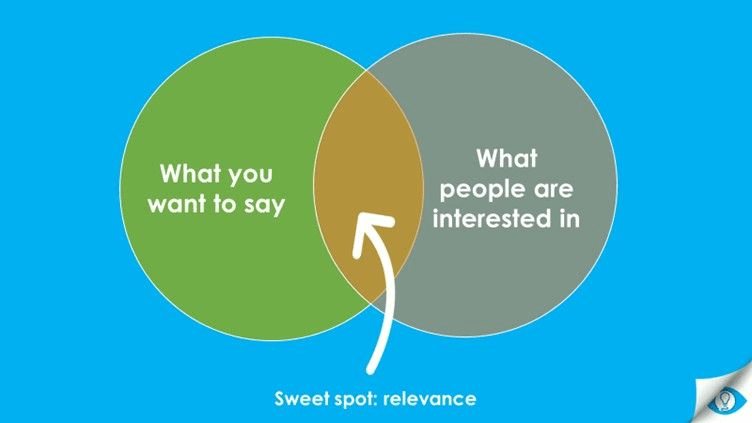
I’ve been thinking about this a lot over the last few weeks while partnering with a client to deliver inspiration sessions on creativity and storytelling. The goal was to inspire global R&D category teams and kickstart new ways of thinking, by combining theory with tangible frameworks to apply to their work.
While these might feel like ‘fluffy’ topics, there’s plenty of data to support the importance of storytelling in business. Our brains are hard-wired to tune into stories. Stories activate areas of the brain that facts and data alone can’t, creating a real connection between the storyteller and listener. And while we often ‘unlearn’ creativity as we get older, it’s a skill which can be developed with the right attitude and frameworks.
So when you’re communicating with stakeholders, whether that’s in a report, on Teams or in a meeting, how often are you really thinking about what they need, versus what you want to say? What are you trying to get them to think, feel or do? How do you build a creative story – even a short one – with tension, transformation, and emotion, to make your communication relevant and drive action?
The same principle applies in marketing, and in qualitative research. What’s the underlying need people have? What problem are they trying to solve and why? What are the emotional, social, and functional benefits they’re looking for? It’s all about tuning into true motivations and drivers of behaviour to improve a product, service or experience, and to market it.
A huge thank you to our client for trusting me to deliver these sessions. It’s about the all-important practical, real-world application. Data and theory in an inspiration session can convince an audience these things are important. But practical and easy to apply frameworks on creativity and storytelling are where the real long-term value in these sessions lies.
*In fact, they probably don’t just want a hole, they want a shelf or a painting on the wall…
 Karen Schofield, keynote speaker & trainer
Leave a comment